Dental phobia directly causes advanced gum disease in a significant portion of the population, and the reason is brutally simple: you cannot treat a problem you keep avoiding. When fear prevents someone from walking through a dental or periodontal clinic door, the bacteria living below their gum line keep working around the clock regardless of how that person feels about appointments. The disease does not wait. The bone does not pause. And by the time fear finally loses out to pain or a crumbling tooth, the damage is almost always far worse than it would have been had that person come in sooner.
This is not a lecture. This is an honest explanation of a cycle that affects millions of people across Canada, including right here in Oakville, and it comes with real, practical ways to break it.
What Dental Phobia Actually Is and How Common It Really Is
Dental phobia is not the same as feeling a little nervous before an appointment. Nervousness is normal. Dental phobia, clinically referred to as dentophobia, is a genuine psychological condition where the fear of dental treatment becomes so overwhelming that it causes people to completely avoid care, sometimes for years or even decades at a time.
Research published in Scientific Reports found that approximately 15 percent of the general adult population experiences dental anxiety significant enough to affect their oral health decisions, while roughly 3 percent meet the clinical threshold for true dental phobia. That 3 percent does not sound like much until you consider that the same study examined these phobic patients under general anesthesia and found that more than half of them, 51.1 percent, showed signs of serious periodontal disease in every sextant of their mouth. That number compared to almost zero in the non-phobic control group.
People with dental phobia are not unlucky. Their gum disease is a direct and predictable consequence of avoidance.

How Fear Creates the Perfect Environment for Gum Disease
Here is what actually happens inside the mouth of someone who avoids dental care due to fear.
The bacterial biofilm known as plaque forms on every tooth surface within hours of brushing. When it is not professionally removed from below the gum line at regular intervals, it hardens into calculus, which is a mineralized deposit that no toothbrush or floss can remove. That calculus then serves as a rough surface where harmful anaerobic bacteria, including Porphyromonas gingivalis, Tannerella forsythia, and Treponema denticola, collectively known as the red complex pathogens, establish themselves and multiply in the protected space between the gum and the tooth root.
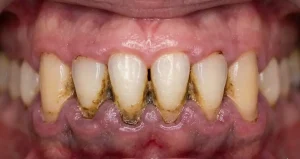
The immune system responds to this bacterial presence with chronic inflammation. Over time that inflammation breaks down the collagen fibres of the periodontal ligament and begins destroying the alveolar bone that holds the teeth in place. This process is called periodontitis, and it is almost entirely silent in its early and moderate stages. No sharp pain. No obvious symptoms that would force someone to act.
For a person without dental phobia, routine professional cleanings interrupt this cycle every six months. For someone who has not been to a dental office in three, five, or ten years because of fear, the disease progresses through its stages completely unchecked
. 
The Vicious Cycle Nobody Talks About Enough
The relationship between dental phobia and gum disease is not just a straight line. It is a loop that tightens over time, and understanding it is important for anyone trying to break out of it.
It works like this. Fear leads to avoidance. Avoidance allows gum disease to develop or worsen. Worsening gum disease means that when someone does eventually get the courage to book an appointment, they find out the damage is more extensive than a regular cleaning can address. They are told they need scaling and root planing, or gum surgery, or bone grafting. That news feels like confirmation of their worst fears, that dental visits mean bad news and painful procedures. So the next time fear whispers that it is easier to cancel, they listen.
Research has consistently demonstrated that the higher a person’s dental anxiety, the longer their avoidance period becomes, and the worse their oral health outcomes are as a direct result. Patients with periodontitis have been shown in peer-reviewed research to carry significantly higher levels of dental anxiety than those without gum disease, and that anxiety tends to worsen their quality of life in ways that extend well beyond their mouth.
Stress Itself Can Make Gum Disease Worse
There is an additional layer to this problem that most people are not aware of. The psychological stress that accompanies dental phobia does not just keep people away from treatment. It may also directly worsen the biological conditions that allow gum disease to progress.
Chronic psychological stress elevates cortisol levels in the body. Elevated cortisol suppresses immune function, reduces the body’s ability to fight off bacterial infection, and increases systemic inflammation. The periodontal environment, which is already under attack from bacterial pathogens in an untreated mouth, becomes even more vulnerable when the body’s immune defences are chronically suppressed by stress. This means a person with dental phobia faces a double disadvantage: their fear keeps them away from the care that would remove the bacteria, while the stress from that same fear may be actively impairing their body’s ability to fight those bacteria on its own.
What Stage of Gum Disease Are You Likely at After Years of Avoidance?
Understanding periodontal staging helps put the consequences of long-term avoidance into perspective.
Stage 1 and Stage 2 periodontitis involve bleeding gums, early bone loss, and pocket depths between 4 and 5 millimetres. At this point scaling and root planing can typically manage the condition very effectively without surgical intervention. The outcome with proper treatment is genuinely excellent.
Stage 3 periodontitis involves significant bone loss, pockets of 6 millimetres or more, and in some cases tooth mobility. Treatment becomes more involved and may require a combination of deep cleaning, locally delivered antibiotics, and in some cases regenerative procedures.
Stage 4 periodontitis is the most severe classification, involving extensive bone destruction, multiple missing teeth, and compromised bite function. Treatment at this stage is complex, lengthy, and significantly more costly than anything that would have been required at Stage 1 or 2.
The painful reality of dental phobia is that people who avoid care often arrive at a periodontist in Oakville presenting at Stage 3 or Stage 4 when their disease could have been intercepted at Stage 1 or 2 had fear not stood in the way. Years of avoidance compress that progression.
Signs That Gum Disease Has Already Advanced While You Were Avoiding Care
If you have been putting off dental visits because of fear, your mouth may already be communicating that something is wrong. These are the signs that warrant urgent attention even if the idea of making an appointment feels overwhelming.
Gums that bleed every single time you brush or eat, rather than occasionally and only with aggressive brushing, are telling you that active gum infection is present. Healthy gum tissue simply does not bleed with normal daily function.
A persistent metallic or unpleasant taste in the mouth, or bad breath that comes back immediately after brushing, is often the result of bacterial activity in deep periodontal pockets. This is not a hygiene problem that brushing harder will fix. It is a sign of infection below the gum line.
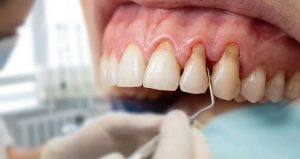
Gums that appear to have pulled back from your teeth, making them look longer, indicate recession. This is a sign that the supporting structures are already being lost.
Teeth that feel slightly loose, have shifted position, or have changed the way they come together when you bite are signalling significant bone loss. At this stage the gum disease is well advanced.
Any one of these symptoms in a person who has not had a periodontal examination recently means that seeing a periodontist in Oakville is no longer something to consider. It is genuinely urgent
What Happens If You Wait Even Longer
People sometimes tell themselves they will go when things get really bad. The problem is that by the time gum disease becomes painful and obvious, the destruction it has caused is permanent. Periodontal bone loss does not reverse on its own. Once the alveolar bone is gone, replacing it requires bone grafting procedures. Once a tooth is lost to advanced periodontitis, replacing it requires dental implant surgery, which itself requires adequate bone volume to succeed.
The irony that every periodontist sees regularly in clinical practice is this: the patients who avoided care because they feared a simple cleaning end up needing the far more involved surgical procedures they were trying to avoid. Their fear of a manageable problem created a situation that required far more extensive treatment.
Practical Strategies That Actually Help People With Dental Phobia Get Treatment
This is where the conversation shifts from what is happening to what you can do about it. These strategies are not theoretical. They are the approaches that actually work for patients who have genuine dental phobia, not just mild nervousness.
Start with a conversation, not a procedure. Many people with dental phobia avoid even making an initial call because they assume the moment they walk in something unpleasant will happen immediately. A good periodontal practice will offer a consultation appointment that involves no treatment, no instruments in the mouth, and no surprises. It is purely a conversation about your concerns, your history, and what care you may need. Ask specifically for this type of appointment when you call.
Tell the office about your fear before you arrive. This sounds uncomfortable but it changes everything. When a clinical team knows a patient has dental phobia before they come in, they can prepare the environment and the conversation differently. They can adjust the pace, explain every step before it happens, and avoid the sudden surprises that tend to trigger the fear response most severely.
Understand exactly what will happen. A significant driver of dental phobia is anticipatory anxiety, the fear of an unknown outcome. When patients have procedures explained to them in specific detail before they begin, including what sensations they will feel and what will be happening at each stage, their anxiety scores in clinical studies drop considerably. Ask your periodontist to walk you through the entire procedure before starting.
Ask about sedation options. For patients with moderate to severe dental phobia, local anesthesia alone is often not enough to manage the anxiety even if it eliminates the pain. Periodontal practices offering conscious sedation, including oral sedation through a prescribed medication taken before the appointment, or nitrous oxide administered during the procedure, can make treatment genuinely tolerable for patients who previously could not sit through it. Oral sedation allows you to remain conscious and able to respond while feeling deeply relaxed. Nitrous oxide wears off quickly and allows most patients to drive home after a short recovery period. Discussing sedation options openly with your periodontist in Oakville is not a sign of weakness. It is a practical clinical tool designed for exactly this situation.
Agree on a stop signal. One of the most powerful anxiety management tools in periodontal practice is simply agreeing on a hand signal before the procedure begins that tells the clinician to stop immediately. Knowing you have that control, that you can pause the procedure at any moment without explanation, removes the sensation of being trapped that drives so much dental phobia. Most periodontists use this routinely but it is worth asking for it explicitly.
Consider cognitive behavioral therapy as a complement to dental treatment. For patients with genuine severe dental phobia rather than situational anxiety, working with a psychologist or therapist trained in cognitive behavioral techniques alongside periodontal treatment has produced excellent outcomes in clinical research. CBT addresses the thought patterns and memory associations that sustain the phobia rather than simply managing symptoms appointment by appointment.
Take the smallest possible first step. If the idea of calling to book a full appointment is too overwhelming, start smaller. Walk past the clinic. Look at the website. Read about the specific procedure you are concerned about. Call and ask one question without booking anything. Each small step reduces the unfamiliarity of the environment that the fear feeds on.
How Periodontal Treatment Has Changed for Anxious Patients
It is worth acknowledging that the periodontal experience patients feared in the past, based on older techniques, is genuinely different from what is available now in a modern Oakville periodontal practice.
Ultrasonic scaling technology has replaced much of the manual scraping that patients found most distressing. Laser gum therapy, for patients whose disease can be managed with that approach, involves no scalpels and significantly less post-procedure discomfort. Local anesthesia delivery has improved dramatically, with topical anesthetics applied before injection that largely eliminate the brief sharpness that many patients dreaded most. The techniques are quieter, faster, and far more comfortable than the same procedures performed even ten or fifteen years ago.
Fear based on an experience from years ago, or on a story from a family member, or on something seen in media that bears little resemblance to modern periodontal practice, deserves to be updated with current information.

For Oakville Patients Who Have Been Putting This Off
There are patients across Oakville, Burlington, Mississauga, and the surrounding Halton Region who have not had a periodontal examination in years, not because they do not care about their health, but because they are genuinely afraid. If that describes you, this is not a judgment. It is an acknowledgment that dental phobia is a real condition that affects people across all education levels, professions, and demographics.
What it is also worth acknowledging is that gum disease is not going to improve on its own while you wait for the fear to pass. The fear and the disease coexist, and both require attention. The good news is that catching gum disease at any stage short of severe is still an opportunity for meaningful intervention. Stage 1 or 2 periodontitis treated promptly responds very well. Even Stage 3 disease can often be managed non-surgically with scaling and root planing in the hands of an experienced periodontist.
The first step does not have to be dramatic. It can simply be a phone call to ask about what a consultation involves and whether any sedation options are available. That is genuinely all it takes to begin reversing a process that has likely been progressing silently for longer than you realize.
Frequently Asked Questions
Can dental phobia cause gum disease directly? Dental phobia causes gum disease indirectly but very effectively. The fear leads to avoidance of professional care, and without professional removal of calculus below the gum line, the bacterial infection that drives periodontitis progresses without interruption. Clinical studies confirm that patients with severe dental phobia show significantly worse periodontal health than non-phobic patients of comparable age and background.
Is it too late to treat gum disease if I have been avoiding the dentist for years? It is very rarely too late to meaningfully treat gum disease. Even advanced periodontitis can be managed in ways that stop the progression and preserve remaining teeth. The earlier treatment begins the better the outcome, but seeking care at any stage is worthwhile. What becomes impossible is recovering bone and tissue that has already been destroyed, which is why beginning sooner rather than later matters so much.
What if I cannot tolerate a periodontal exam without panicking? This is more common than most patients realise and a good periodontal practice is equipped for it. Options include going at your own pace, having the exam explained step by step before anything happens, using a stop signal throughout, requesting oral sedation, or asking for nitrous oxide. You do not have to simply endure the experience. Accommodations exist specifically for patients in your situation.
Will the periodontist judge me for the condition my mouth is in? No. Periodontists see the consequences of dental phobia regularly in clinical practice and they understand the psychological barriers involved. Their concern is treating what is there, not evaluating the choices that led to it. Coming in at all, in spite of the fear, is the part that matters.
How quickly does gum disease worsen in someone with dental phobia who avoids treatment? The rate of progression varies depending on individual factors including genetics, smoking status, systemic health, and the specific bacterial composition in the mouth. For some people the disease progresses slowly over many years. For others, particularly those with diabetes, immune conditions, or who smoke, it can advance through multiple stages within a relatively short period. There is no safe waiting period.